28 October 2026 · 8 min read
Why Are Some Perfume Ingredients More Expensive Than Gold?
Discover why rare perfume ingredients like oud, orris and natural rose oil can command extraordinary prices, and what makes them so valuable.
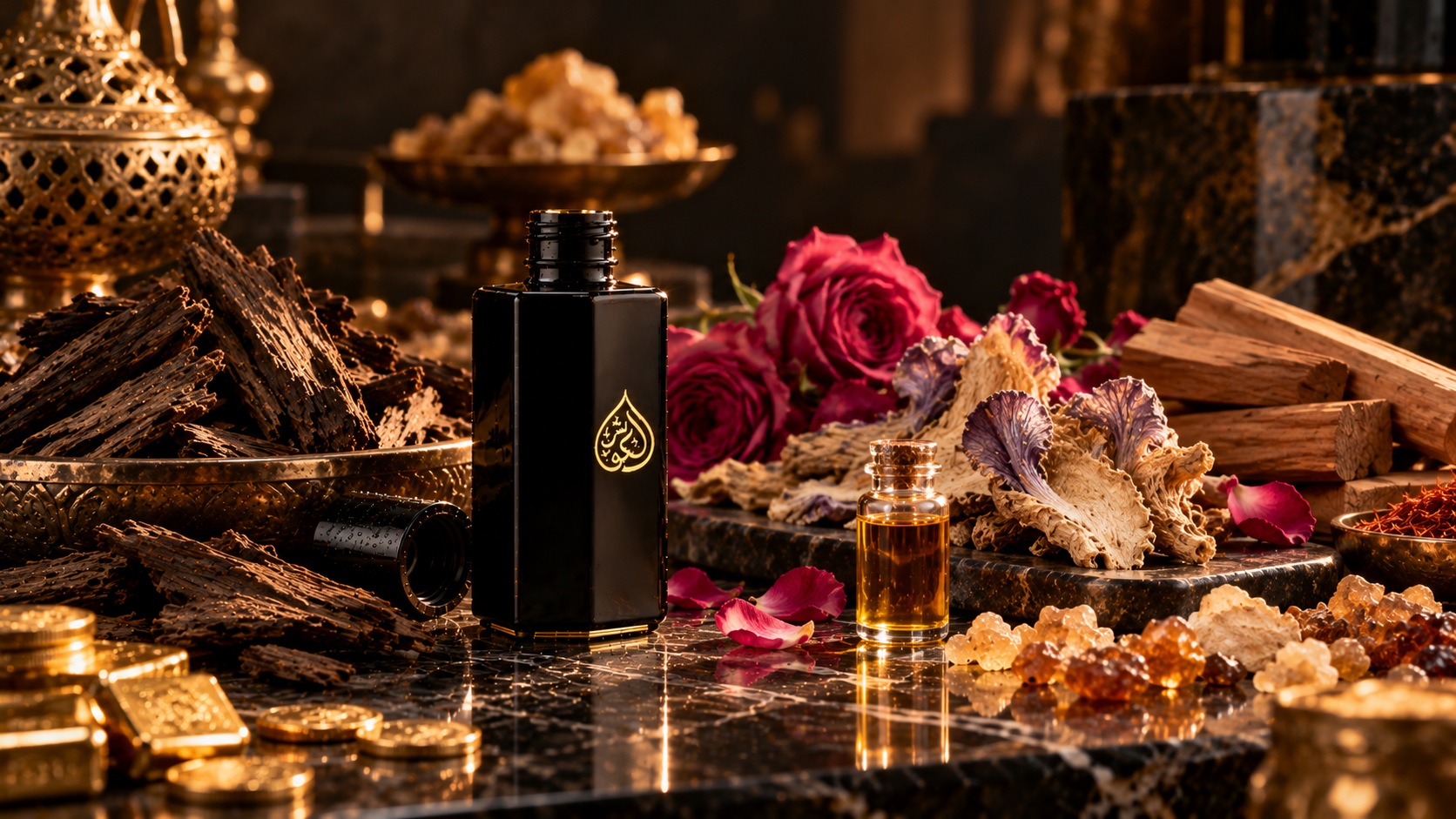
Imagine holding two small bottles.
One contains an ordinary fragrance ingredient worth a few euros.
The other contains a rare natural aromatic material worth hundreds, perhaps even thousands.
Both bottles look almost identical.
Yet their prices couldn't be more different.
How can something measured in millilitres become so valuable?
Some exceptional perfume materials can command prices exceeding the value of an equivalent weight of gold, although this is far from true of every natural ingredient.
The explanation involves much more than luxury branding.
Behind certain fragrance materials are years of cultivation, extraordinary quantities of raw ingredients, difficult extraction processes and limited natural resources.
Let's explore the fascinating economics of perfumery.
1. Oud: The Fragrance Born From a Tree's Defence Mechanism
Oud is one of the most fascinating materials in perfumery.
It comes from resin-rich wood associated with certain trees, particularly species belonging to the Aquilaria and Gyrinops genera.
But here's what makes oud unusual.
Not every agarwood-producing tree contains valuable resinous wood.
Under certain conditions, including biological stress and infection, trees can develop resin-rich areas within their wood.
This resinous material is responsible for the characteristic aroma associated with agarwood.
The formation process can take years, and the quality of the resulting material varies enormously.
Why is natural oud so expensive?
Several factors influence its value:
- Limited supply: High-quality naturally formed agarwood can be difficult to obtain.
- Time: Resin development and tree cultivation can require many years.
- Extraction: Producing oud oil involves processing resinous wood, often through distillation.
- Variable yields: The amount and quality of oil obtained depend on the wood and extraction conditions.
- Demand: Oud has a long history of cultural importance, particularly in Middle Eastern and Asian fragrance traditions.
Some exceptional oud oils sell for extraordinary prices.
However, oud prices vary dramatically depending on origin, quality, authenticity and market conditions.
Not every oud oil is more expensive than gold.
In fact, many products described as oud fragrances use carefully constructed accords rather than substantial quantities of natural oud oil.
Does expensive oud always smell better?
Not necessarily.
Some people prefer the intense, animalic and leathery character of certain natural oud oils.
Others prefer smoother, sweeter or more approachable oud compositions.
Price can reflect rarity and production costs, but fragrance appreciation remains subjective.
A rare ingredient is not automatically a beautiful ingredient to every nose.
2. Orris Butter: An Ingredient That Can Take Years to Produce
Imagine growing a plant for several years, harvesting its underground stems and then waiting several more years before processing them into a valuable fragrance material.
That is part of the remarkable story of orris.
Orris comes from the rhizomes of certain iris species, including Iris pallida.
The plant is cultivated for its aromatic potential rather than its flowers.
What makes orris so special?
Freshly harvested iris rhizomes do not immediately possess the full characteristic aroma associated with mature orris.
They are traditionally dried and aged.
During this period, chemical changes contribute to the development of important aromatic compounds, including irones.
Irons are among the compounds responsible for orris's distinctive powdery, woody and violet-like character.
The material may then undergo further processing to produce orris butter or other extracts.
Why does it cost so much?
The process involves:
- Years of cultivation.
- Labour-intensive harvesting and preparation.
- Extended drying and ageing.
- Specialised extraction.
- Relatively limited quantities of valuable aromatic material.
High-quality orris butter can command extremely high prices, particularly when it contains a substantial concentration of irones.
Depending on its quality and the market, exceptional grades can be among the most expensive natural perfume materials.
And here's the surprising part.
The valuable aromatic material doesn't come from the beautiful iris flower. It comes from the underground rhizome.
3. Rose Oil: Thousands of Flowers for a Small Amount of Fragrance
A rose may look delicate and ordinary.
But producing concentrated natural rose oil is anything but simple.
Rose oil is traditionally obtained through distillation of fragrant rose petals.
Two important roses used in perfumery are Rosa damascena and Rosa centifolia, although the extracts and production methods associated with them differ.
Why is rose oil expensive?
The main reason is the enormous amount of plant material required.
Depending on the rose variety, growing conditions and extraction process, several tonnes of rose petals may be needed to produce approximately one kilogram of distilled rose oil.
The exact yield varies.
This means a small bottle of genuine rose oil represents an extraordinary quantity of flowers.
The importance of harvesting
Rose petals are often harvested early in the day, when conditions favour the preservation of their aromatic characteristics.
Harvesting and processing require careful timing.
Delays, weather conditions and handling can affect the resulting material.
Unlike a synthetic aroma chemical manufactured through a controlled industrial process, agricultural production is exposed to seasonal uncertainty.
A poor harvest can reduce supply.
A strong harvest may improve availability.
These fluctuations can influence prices.
Does natural rose oil smell like a fresh rose?
Not exactly.
Fresh roses release a complex mixture of aromatic compounds into the air.
Distilled rose oil contains a particular selection and balance of compounds influenced by the extraction process.
It can smell rich, floral, honeyed, spicy or green, depending on its composition.
But it is not a perfect reproduction of the experience of smelling a living rose.
4. Sandalwood: When a Tree Becomes a Valuable Fragrance Resource
Sandalwood has been treasured for centuries.
Its smooth, creamy and woody aroma makes it valuable in perfumery.
One of the most historically important species is Santalum album, commonly known as Indian sandalwood.
Why is natural sandalwood valuable?
Sandalwood trees require time to mature.
The aromatic oil is concentrated in particular parts of the tree, especially the heartwood and roots.
Oil quality and yield vary with factors such as species, age and growing conditions.
This makes sandalwood production very different from harvesting an annual crop.
You cannot simply plant a tree and expect high-quality sandalwood oil a few months later.
The sustainability challenge
Historical overharvesting and illegal trade have affected certain sandalwood resources.
Conservation rules, cultivation programmes and traceable sourcing have therefore become important considerations.
However, different sandalwood species have different conservation statuses and supply conditions.
It would be misleading to describe every sandalwood species as endangered.
For responsible fragrance businesses, identifying the species and understanding the source of the material are important steps.
A valuable natural ingredient should not come at the expense of the resource that produces it.
5. Jasmine Absolute: The Hidden Cost of Delicate Flowers
Jasmine is another important natural material in perfumery.
Its aroma can be floral, sweet, green, fruity and sometimes subtly animalic.
But jasmine flowers are delicate.
Producing jasmine absolute requires substantial quantities of blossoms and careful extraction.
Why is jasmine absolute expensive?
Jasmine production can involve:
- Labour-intensive flower harvesting.
- Careful handling of delicate blossoms.
- Large quantities of flowers.
- Solvent extraction and further processing.
- Agricultural and seasonal variability.
The result is a concentrated aromatic extract used in fine perfumery.
However, natural jasmine absolute is not the only way to create a jasmine fragrance.
Modern perfumers can also use individual aroma chemicals and reconstructed accords to produce beautiful jasmine-like effects.
6. Why Doesn't Every Expensive Perfume Contain Expensive Ingredients?
Here's something many consumers misunderstand.
The retail price of a perfume does not directly reveal the cost of its ingredients.
A perfume's selling price can include far more than the fragrance concentrate.
Businesses must account for packaging, manufacturing, quality control, regulatory compliance, distribution, marketing, retail margins and other operating expenses.
Brand positioning can also influence pricing.
Two perfumes sold at similar prices may have very different ingredient costs.
Likewise, a fragrance containing an expensive natural material may use it in a relatively small quantity.
This is not necessarily a problem.
Perfumery is about constructing a balanced composition, not simply adding as much expensive material as possible.
7. Why Can Synthetic Ingredients Sometimes Be Better Than Natural Ones?
Natural materials have an important place in perfumery.
But synthetic fragrance ingredients are equally important.
Some aroma chemicals make it possible to create scent effects that would be difficult or impractical to obtain directly from nature.
Others provide consistency, stability or alternatives to scarce natural resources.
Synthetic materials can also reduce dependence on certain environmentally sensitive ingredients.
However, synthetic does not automatically mean sustainable, just as natural does not automatically mean environmentally friendly.
The environmental impact depends on how an ingredient is produced, sourced and used.
Does natural mean safer?
Not necessarily.
Natural essential oils and extracts can contain substances capable of causing irritation or allergic reactions.
Synthetic fragrance ingredients can also present safety considerations.
Safety depends on the specific substances, their concentrations, the formulation and the intended use.
The quality of a perfume cannot be judged simply by whether its ingredients are natural or synthetic.
8. Can a Perfume Ingredient Really Be Worth More Than Gold?
Yes, certain exceptionally rare or highly refined natural fragrance materials can reach prices exceeding the value of gold by weight.
But this statement requires context.
Gold has a widely quoted market price.
Natural perfume ingredients do not necessarily have one standard global price.
Their value can vary significantly according to:
- Authenticity.
- Geographic origin.
- Botanical species.
- Extraction method.
- Chemical composition.
- Age and storage conditions.
- Supplier and market demand.
A particularly rare oud oil or high-grade orris material might command an extraordinary price.
But that does not mean all oud, orris or natural perfume ingredients are worth more than gold.
The comparison is interesting because it reveals just how valuable certain aromatic materials can become.
9. Does an Expensive Ingredient Make a Better Perfume?
This brings us to perhaps the most important question.
Imagine a perfume made using several extremely expensive natural ingredients.
Now imagine another perfume made using a combination of carefully selected natural and synthetic materials.
Which one smells better?
There is no universal answer.
A skilled perfumer must consider balance, harmony, diffusion, stability and the intended character of the fragrance.
An expensive ingredient can contribute something remarkable.
But it cannot rescue a poorly balanced composition.
Similarly, an affordable ingredient can be essential to a beautiful fragrance.
The art of perfumery lies in knowing how ingredients work together, not simply how much they cost.
The Bottom Line
Why are some perfume ingredients so expensive?
Because certain aromatic materials require extraordinary amounts of time, labour, raw materials and expertise to produce.
Oud may depend on years of resin development.
Orris requires prolonged cultivation and ageing.
Rose oil can require tonnes of petals.
Sandalwood depends on slow-growing trees and responsible resource management.
These materials remind us that behind a tiny bottle of fragrance can be an entire world of agriculture, chemistry, craftsmanship and history.
At Al Kowthar Fragrances, we believe that understanding the ingredients behind perfume makes the experience of wearing fragrance even more meaningful.
The next time you encounter a beautiful natural oud, rose or sandalwood fragrance, consider the remarkable journey that may have brought its aromatic materials into the bottle.
Sometimes the smallest quantity of fragrance carries the greatest story.
"Explore Al Kowthar Fragrances" (https://alkowtharfragrance.com/shop)